Barbara Amos’s Realidoscope
In recent years Barbara Amos has been playing with the idea of cutting up the imagery in her paintings, visually rearranging it and then putting it back together, so to speak, on the surface of the canvas. Her Calgary-based urban series, “Cutting up the Town” and more recently, the Banff-based series “Cutting up the Park” employed this idea in a literal sense. In these, she painted scenes of downtown Calgary and iconic Canadian landscapes such as Lake Louise and Mount Rundle on uniform, one foot square sections of canvas that could then be rearranged. These works recall those small plastic frames holding moveable squares of pictures where the objective was to put the image back together in its proper order. Simple, amusing children’s trinkets. In Amos’s painted cut-ups, the upside down and mixed up imagery amuses on an entirely new level: triggering notions of the politics of land use, cities and population density, commerce and industry, tourism verses conservation, the dichotomy between the way we see the land and the way we use the land, and our confusing and too busy present day world. Simple and complex all at once, the cut-up paintings allow us to play with various notions of the way we see our surroundings by arranging the scene in a new way: mixed up.
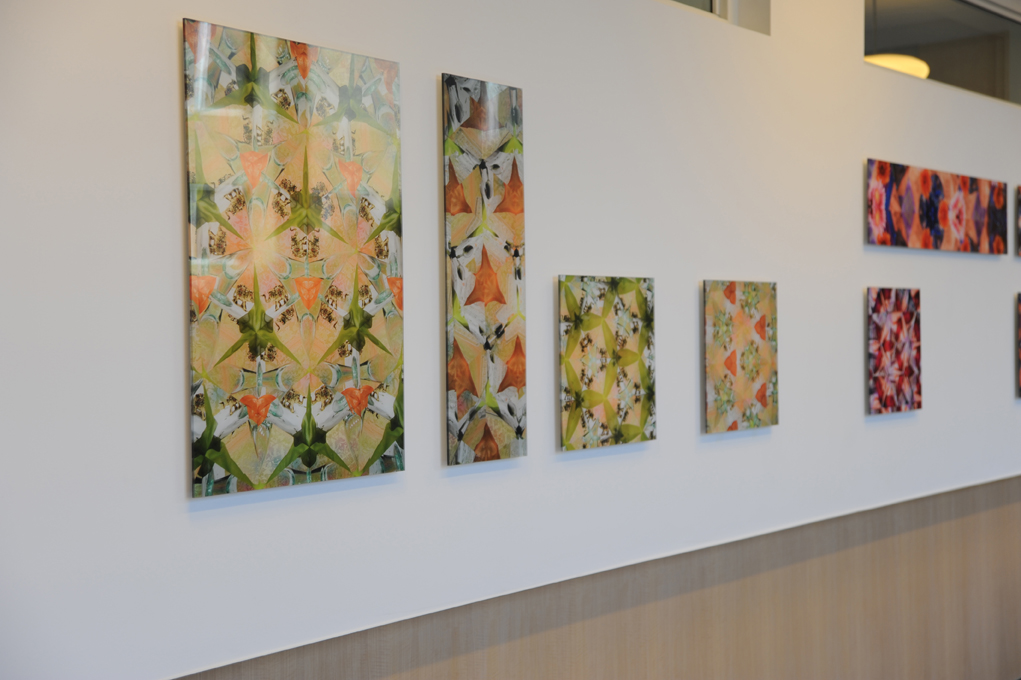
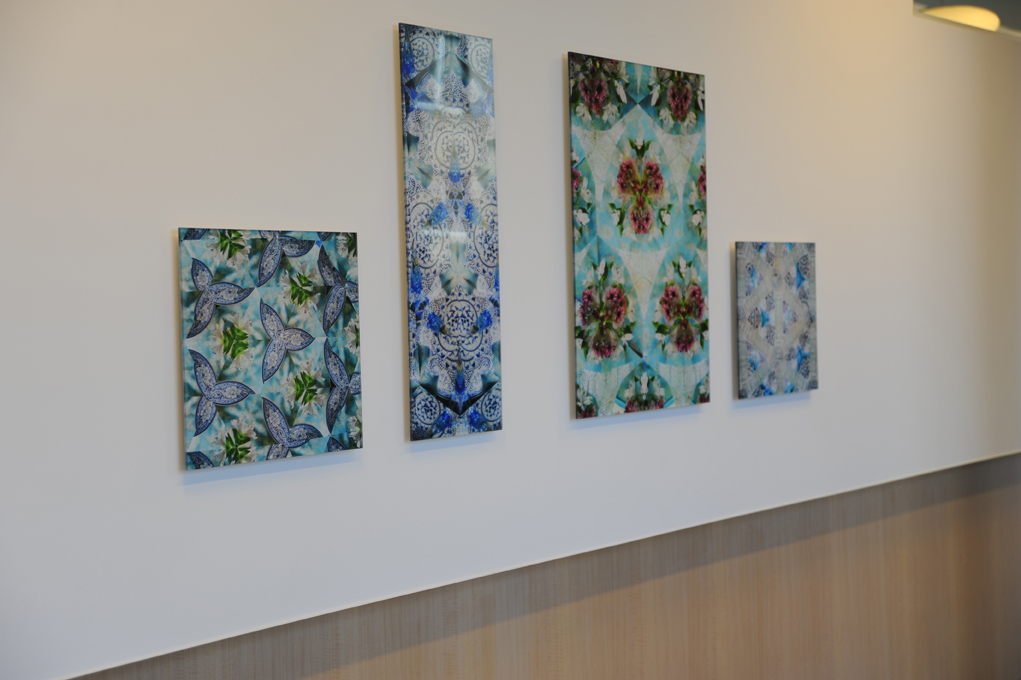
Following this work, building on her idea of cut-ups, and playing with another wonderfully simple old-fashioned childhood toy: the kaleidoscope, Amos plays with the optics and visual perception, this time capturing the imagery for us in photographs. Her Realidoscope Lens, created to explore this process, allows us not only to see what she sees, but to look through the Lens ourselves. It is an invitation to lift the restrictions we put on the way we see the world, restrictions of order and sense, where roads go somewhere, trees grow upwards, the sky is above us and the ground is beneath our feet. Through her Lens, we are presented with a mixed up, reflected, and broken landscape as might be seen through kaleidoscope. Without the interference of coloured bits of glass or beads as are often found in the children’s toy versions, or the rounding of straight lines that results from the addition of a clear glass ball as found in a teleidescope, we see the subject cut simply into small triangles and rearranged.
Amos played with a kaleidoscope as a child; she was given one to amuse her while riding in the backseat of the family car on long trips in northern Ontario. The landscape rolling by as she travelled, the interior of the car, her fellow passengers, were hers to dissect. To a child, this is mere diversion; funny, intriguing, ever changing. But this focused act of looking, and the ability to manipulate what we see, is both empowering and fascinating. The feeling remained with her throughout her life, the joy of breaking things apart visually, and the interesting image that resulted. Increasingly, the parallels between this fragmented world and the multifaceted, incredibly complex reality in which we live in the 21st century occupied her thoughts, wherein priorities compete and vie for our attention. Her frustration that she could never hold the kaliedescope image long enough to share it with another, as the slightest movement of the kaliedescope would change the image, was matched by the constant and sudden shifting of priorities in daily life, both on a personal scale and a greater scale within the world. This fascination with the rearrangement of the visual world led Amos to create the Realidoscope Lens.
Amos’s lens is uncomplicated: a hefty metal tube about a foot long, lined with mirrors, and having a simple lens at the end. Looking through it, you will see your subject broken into multiple triangles, reflected back one upon another. All of these broken bits are easily moved around by rotating the tube ever so slightly. That this simple Lens produces such a complex visual experience is part of the attraction of this work. The experience transports us back to those childhood moments of visual joy when the changing patterns in the end of the kaleidoscope lens became our primary focus. The urge to move the lens ever so slightly, to watch the image form and reform itself, is irresistible. Shaping and reshaping the land through Amos’s lens is an exciting, contemplative, yet supremely simple pleasure. Unrelated sections of the vista are forced side by side, turned upside-down and angled against each other. The visual comfort we can find in the uniformity of the patterning, contrasted with the obviously ‘wrong’ way we see the landscape, is intriguing. We are forced to look at the parts, rather than the whole, without the anchor of horizon lines, uniform tree tops, the continuity of the surface of water, or other recognizable elements to link it all together in a way that makes sense. Nature becomes simply pattern, light bendable, we can ascend the sky.
This experience, of visually capturing disorder, change, and the ever increasingly complex world in which we try to function as humans is what Amos seeks in her work. Our worlds: societal, cultural, demographic, geographic, are easily and continually rearranged, displaced, and reflected back upon each other as is the landscape when viewed through the Realidoscope Lens, and as beings, we must adjust just as quickly to understand it. Amos’s work is a metaphor for our kaleidoscoping world, where the pace of change is often at odds with the need for debate and thoughtful consideration, where change can be both wonderful and confusing, frightening and uncomfortable, enlightening and alarming all at once. How we respond to all this change is the key to how we function as citizens, to the strength of our communities, to the success of our multicultural societies, and to managing in our ever-changing world. We have to cope in order to succeed, and in coping we find new ways to understand our world. Amos’s Realidescope engages us in exactly this way, forcing the world into a state of confusion, were we must sort through the puzzle in order to comprehend and move forward.
Amos has taken numerous photographs through the Lens, satisfying that urge to capture what she sees and share it with others. This work is mathematical, geometric, and wildly random all at once. These photographs, and the moment of decision, are two completely elusive moments, one captured for us by Amos, the other gone in the flow of the day. It is this transitory nature of the image we see that is so intriguing, captured by the Realidoscope Lens, a stark acknowledgement of other viewers having had a similarly insular personal experience to the one we have had while looking through the Lens, and evidence of the fact that we are all living in the wildly fast paced world of today, where we cope and try to make sense of things as they tumble in and out of focus.
Lisa Christensen
Lisa Christensen an independent curator and art historian, author of the three books and winner of the W.O. Mitchell Book Prize, Book Publishers Association Title of the Year Award and the H. Kriesel Award for Best First Book. She has worked as an Associate Curator of Art at the Glenbow Museum in Calgary and as Curator of Art, at the Whyte Museum, Banff and is now the Calgary agent for Heffel Fine Art.
Please click the Back button to return to the previous page.
